Greta Loewen
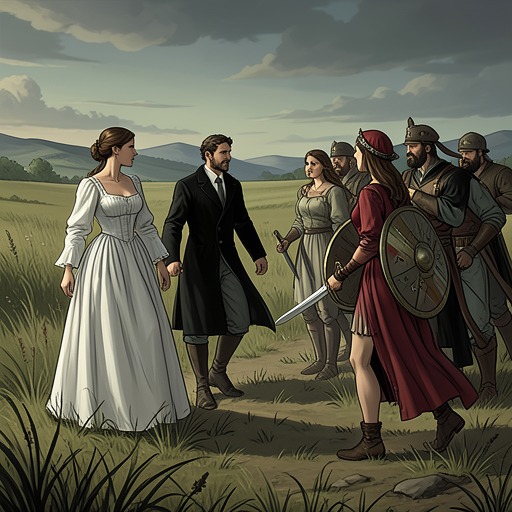
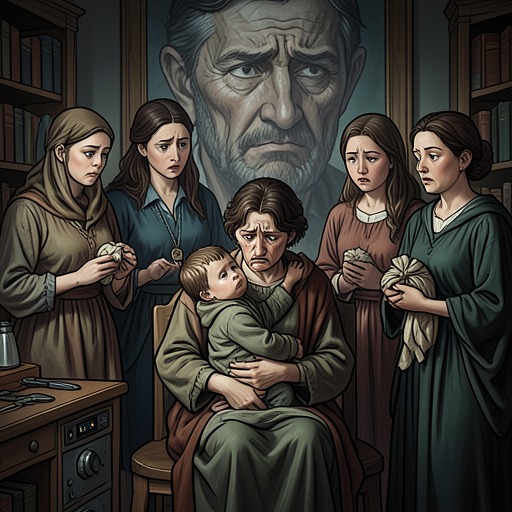
Women TalkingGreta Loewen, born a Penner and the eldest of the Loewen women, gives the women’s debate a distinctive practical authority. She understands fear through the behavior of horses and the handling of a buggy, and uses that experience to argue that leaving Molotschna can be both a means of protection and an expression of faith. Her interventions also bring the danger inside the colony into direct view, especially when she confronts Mariche Loewen about the threat posed by Mariche’s husband, Klaas Loewen.
Identity and Perspective
Greta speaks with a melancholic dignity, but her arguments are concrete rather than abstract. She draws on the work and movement of horses to test the women’s competing ideas about safety: what matters is not whether a response looks orderly or courageous, but whether it avoids harm. Her stories give the meeting’s deliberation a material vocabulary of roads, reins, animals, and judgment.
As the eldest of the Loewen women, though born a Penner, Greta occupies a place within the group from which she can speak forcefully. She does not leave the discussion at the level of principle. Her interventions connect the women’s collective decision to immediate risks and to the practical knowledge needed to move safely through them.
Horses as a Measure of Danger
Greta recalls that when Ruth and Cheryl are frightened by a dog on the mile road to church, their instinct is to run. The horses do not hold a meeting to decide what to do; they flee the danger. Greta uses their response to challenge deliberation that might become an excuse for remaining exposed. When Agata Friesen objects that the women are not animals, Greta answers that they have been preyed upon like animals and might need to respond accordingly.
The comparison is pointed rather than simple. Greta does not argue that the women are literally animals; she insists that their treatment makes the comparison impossible to ignore. The horses’ flight offers a practical example of survival, while the women’s meeting must still reckon with the consequences of acting together. Greta’s parable presses the group to distinguish considered protection from passive endurance.
Leaving as an Act of Faith
Greta develops the argument through another story about Ruth and Cheryl. The road between Molotschna and Chortiza Colony is narrow, with deep gullies on either side. She used to fear it and, before learning to look far ahead, drove the buggy in perilous side-to-side movements. The horses followed the commands on the reins, but those commands were jerky and dangerous. For Greta, the change came from fixing her gaze down the road rather than on the ground immediately before the team.
She applies that lesson to the women’s decision: leaving can provide the longer perspective needed to forgive, love properly, and keep peace according to their faith. In her account, departure is not cowardice, abandonment, disobedience, rebellion, or proof that the women have been excommunicated or exiled. She describes it instead as a supreme act of faith in God’s abiding goodness. The road story makes that claim practical: faith requires attention to where a choice leads, not merely obedience to the immediate pressure to stay.
Confronting Immediate Threats
Greta’s concern for safety becomes sharply specific when Mariche objects to the narrator’s attempt to guide the discussion. Greta stands and rebukes her for directing her anger at the women while Klaas is about to return. She warns that he will take his animals to sell them for bail money, which could bring the accused men back to Molotschna, and that he will again lay hands on Mariche and the children. Greta’s outburst identifies the danger both beyond the household and within it, while challenging Mariche’s silence toward her husband and her anger toward the women.
The rebuke interrupts the meeting; the women fall silent, and the narrator apologizes for trying to steer proceedings. Greta’s intervention therefore does more than express alarm. It redirects attention to the consequences of the women’s choices and to the unequal pressures shaping their participation in the debate. Her warning is forceful, but its focus is on the risk that delay and misplaced anger will leave Mariche and the children exposed.
The Collective Stakes of Departure
Greta also asks whether Cornelius is ready to leave and whether his wheelchair has been packed. She learns that he will remain because his mother belongs to the Do Nothing women and he has no choice but to stay with her. The answer makes the limits of the women’s departure visible: their plans cannot automatically carry every child or dependent person with them, and a family’s position in the debate can determine who is able to go.
Across these moments, Greta’s horses and roads are not decorative stories but instruments of judgment. They let her connect immediate danger to the longer consequences of a decision, and her defense of leaving rests on a combination of practical caution and religious conviction. She insists that protection and faith need not be opposites: looking farther ahead may be what allows the women to preserve both.